> For the complete documentation index, see [llms.txt](https://docs.zenml.io/llms.txt). Markdown versions of documentation pages are available by appending `.md` to page URLs; this page is available as [Markdown](https://docs.zenml.io/user-guides/production-guide.md).
# Production guide
Level up your skills in a production setting.
The ZenML production guide builds upon the [Starter guide](/user-guides/starter-guide.md) and is the next step in the MLOps Engineer journey with ZenML. If you're an ML practitioner hoping to implement a proof of concept within your workplace to showcase the importance of MLOps, this is the place for you.
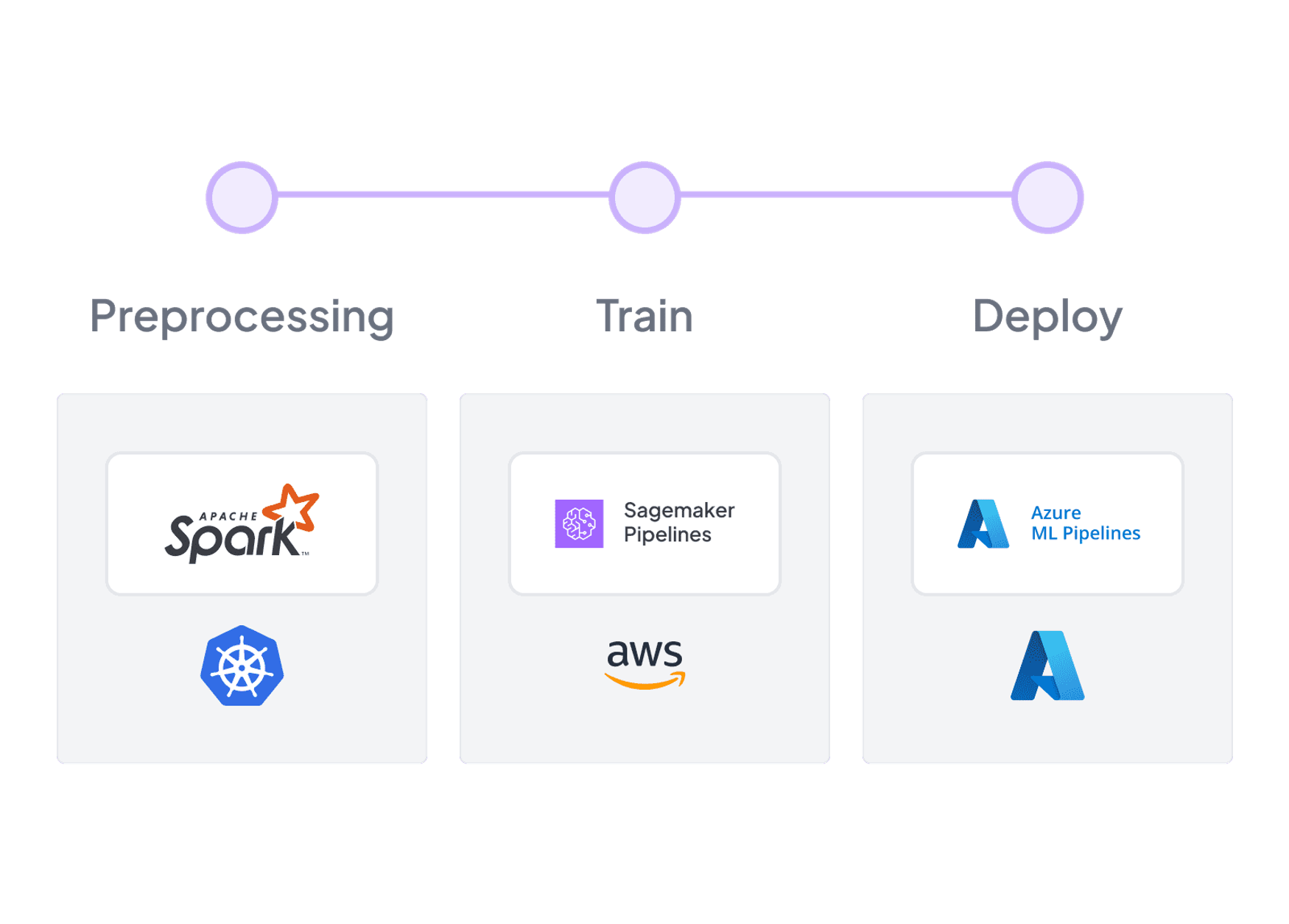
ZenML simplifies development of MLOps pipelines that can span multiple production stacks.
This guide will focus on shifting gears from running pipelines *locally* on your machine, to running them in *production* in the cloud. We'll cover:
* [Deploying ZenML](/user-guides/production-guide/deploying-zenml.md)
* [Understanding stacks](/user-guides/production-guide/understand-stacks.md)
* [Connecting remote storage](/user-guides/production-guide/remote-storage.md)
* [Orchestrating on the cloud](/user-guides/production-guide/cloud-orchestration.md)
* [Configuring the pipeline to scale compute](/user-guides/production-guide/configure-pipeline.md)
* [Configure a code repository](/user-guides/production-guide/connect-code-repository.md)
Like in the starter guide, make sure you have a Python environment ready and `virtualenv` installed to follow along with ease. As now we are dealing with cloud infrastructure, you'll also want to select one of the major cloud providers (AWS, GCP, Azure), and make sure the respective CLIs are installed and authorized.
By the end, you will have completed an [end-to-end](/user-guides/production-guide/end-to-end.md) MLOps project that you can use as inspiration for your own work. Let's get right into it!
{% hint style="info" %}
Throughout this guide, we will be referencing internal ZenML functions and classes, which are more easily discoverable in the [SDK Docs](https://sdkdocs.zenml.io/). Consult the SDK docs if you're ever stuck!
{% endhint %}
---
# Agent Instructions
This documentation is published with GitBook. GitBook is the documentation platform designed so that both humans and AI agents can read, navigate, and reason over technical content effectively. Learn more at gitbook.com.
## Querying This Documentation
If you need additional information that is not directly available in this page, you can query the documentation by asking a question.
Perform an HTTP GET request on the following URL with the `ask` and `goal` query parameters:
```
GET https://docs.zenml.io/user-guides/production-guide.md?ask=&goal=
```
`ask` is the immediate question: it should be specific, self-contained, and written in natural language.
`goal` is what the user is ultimately trying to achieve, the reason they need the answer. Sharing it helps GitBook give you a better, more relevant answer. A goal is most helpful when it describes the outcome the user wants rather than restating the question. For example, with `ask=how do I create an API token`, a goal like `automate deployments from our CI pipeline` lets GitBook tailor the answer to that use case.
The response will contain a direct answer to the question and relevant excerpts and sources from the documentation.
Use this mechanism when the answer is not explicitly present in the current page, you need clarification or additional context, or you want to retrieve related documentation sections.